I am going to be honest with you: as a CPA, I never particularly liked T accounts. They always felt like one more thing to memorize. Which side is which? Where does each account go? At first they look like a diagram layered on top of the same debit and credit problem you already had.
But for a lot of accounting students, T accounts are the thing that finally makes debits and credits click. And they are not only a classroom exercise. Large ERP systems, including Oracle, have a T accounts button built into the software. You open a journal entry, click it, and the system draws that entry out as T accounts showing you exactly which accounts were affected and how.
So this tool is clearly doing something for somebody.
Here is the plan. First I will show you exactly what a T account is and how to use one. Then we will post six business transactions to T accounts, because if this works for so many people it might work for you. At the end, you decide. Maybe T accounts become your go-to tool. Maybe, like me, you skip them. Either way you will know exactly what they do and whether they are for you.
What You’ll Learn
- T accounts organize each account’s debit activity on the left and credit activity on the right.
- Every journal entry must have total debits equal to total credits, even when three or more accounts are affected.
- Posting multiple transactions to the appropriate T accounts makes account balances and changes easier to see.
- T account balances roll forward into the general ledger, the trial balance, and ultimately the financial statements.
- T accounts reinforce debit and credit patterns but do not replace learning the underlying accounting rules.
What Is a T Account?
A T account is a quick sketch of one general ledger account.
You draw a horizontal line across the top and write the account title above it. Then you draw a vertical line straight down from the middle of that horizontal line. The two columns that result are the whole tool:
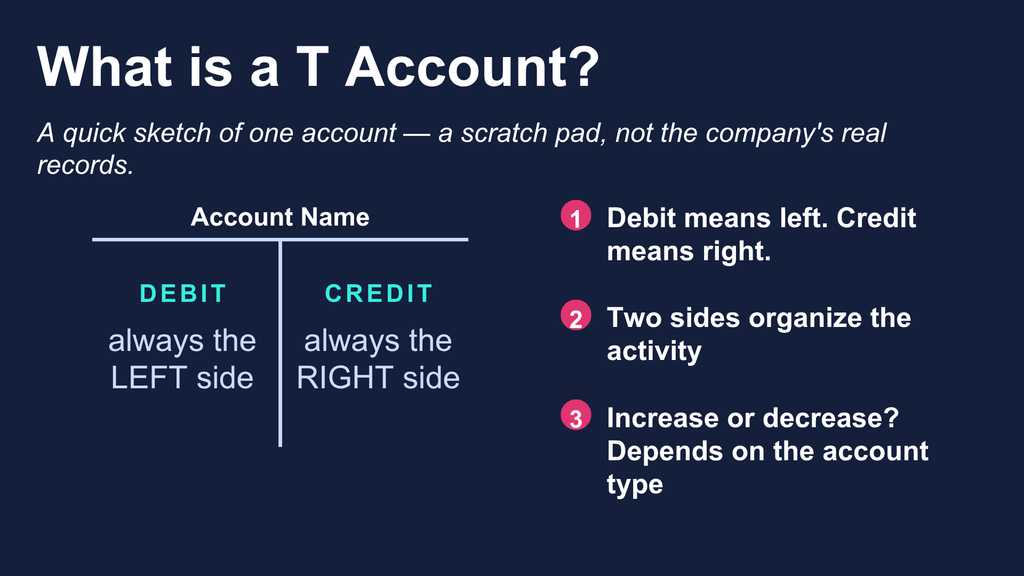
The left side is always the debit side. The right side is always the credit side. That is the entire structure.
T accounts are not the company’s formal accounting records. They are a scratch pad — an analysis tool for seeing what a financial transaction does to a specific account, one account at a time.
And they clear up the most confusing thing about debits and credits immediately.
Debit does not mean bad. Credit does not mean good. They do not mean increase or decrease either.
Debit means left. Credit means right.
Whether a debit entry increases or decreases an account depends entirely on the type of account you are working with. Assets increase with debits. Liability accounts and equity accounts increase with credits. Revenue accounts increase with credits, and expense accounts increase with debits.
T accounts do not replace those accounting rules. They give you a consistent place to practice them.
New to this? Start with debits and credits explained before you work through the examples below.
How to Calculate a T Account Balance
As transactions occur, you add each debit entry and credit entry to the appropriate side of the relevant T account. The activity accumulates. To find the ending balance, total both sides and take the difference.
- If the debit side totals more, the account has a debit balance.
- If the credit side totals more, the account has a credit balance.
For example, if the cash account has $5,600 of debits and $2,000 of credits, its ending balance is a $3,600 debit balance. The balance is not a separate transaction. It is simply the net result of all activity posted to that account.
T Accounts and the Double Entry System
You never work with just one T account when posting a transaction. Every business transaction affects at least two accounts. That is the core of double entry accounting.
It is worth being precise here, because the name misleads people. Double entry bookkeeping does not mean every transaction affects exactly two accounts. A financial transaction can affect three, four, or more. The requirement of the double entry system is not a count of accounts. The requirement is that total debits always equal total credits.
This is what separates a double entry accounting system from the single entry systems a very small business might use. Single entry systems record one side of a transaction, usually the cash effect, the way a checkbook register does. They tell you what happened to cash. They cannot tell you what you own, what you owe, or whether your books are internally consistent. Double entry captures both sides of every transaction, which is what makes financial reporting and accrual accounting possible in the first place.
When I use T accounts, I think of each journal entry as being broken apart and posted into the individual accounts it affects. The journal entry shows the transaction as a whole. The T accounts show what that transaction did inside each account.
Which Accounts Increase With Debits?
Before we post anything, here are the accounting rules the T accounts are going to reinforce. Keep this table nearby while you work through the examples.
Account type | Increases with | Decreases with | Normal balance | Example account titles |
|---|---|---|---|---|
Asset account | Debit | Credit | Debit | Cash, Accounts Receivable, Equipment |
Liability accounts | Credit | Debit | Credit | Accounts Payable, Loans Payable |
Equity accounts | Credit | Debit | Credit | Common Stock, Retained Earnings |
Revenue accounts | Credit | Debit | Credit | Service Revenue, Sales Revenue |
Expense accounts | Debit | Credit | Debit | Rent Expense, Salaries Expense |
Read the middle columns in both directions. Debit entries increase assets and expenses, and debit entries decrease liabilities, equity, and revenue. That second direction is the one people forget, and it shows up in transaction six below.
If you use a mnemonic like DEALER to remember which accounts increase with debits, keep using it. T accounts do not replace it. I cover it in detail in the debits and credits lesson series.

How to Organize Your T Accounts
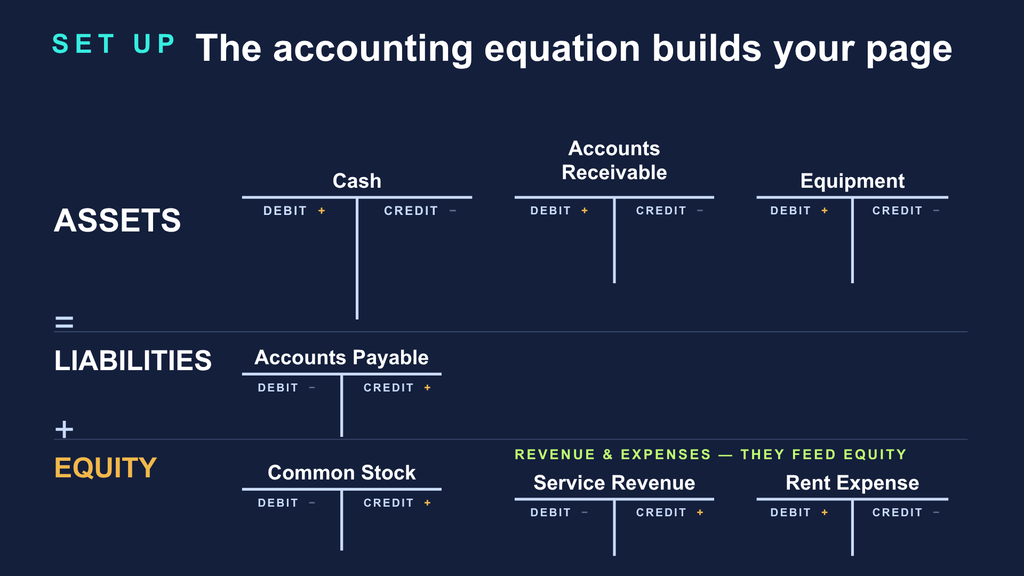
The best way to lay out T accounts is to mirror how the balance sheet is built, which follows the basic accounting equation:
Assets = Liabilities + Equity
So put asset accounts on the first row. Liability accounts on the second. Equity accounts next. Revenue and expense accounts go below equity, because they are the accounts that feed into shareholders equity accounts at the end of the accounting period through retained earnings.
Your page becomes a rough visual representation of the financial statements you are building toward. That organization matters more than it sounds like it should, especially once several transactions are hitting the same accounts.
Six T Account Examples for a Small Design Studio
Let’s say I am tracking the first month of a small design studio. I will work through six transactions. For each one I will identify the accounts involved, determine the journal entry, and post the activity to the T accounts so you can see how the debits and credits land.
1. Owner Invests $5,000 Cash
The owner invests $5,000 cash to start the business.
Ask yourself: what accounts are affected? If the owner invests cash to start a business, it means the owner contributes the cash and is issued common stock in return. So the accounts involved are Cash and Common Stock.
Cash is increasing by $5,000. Cash is an asset account, and assets increase with debits, so $5,000 goes on the left or debit side of the cash T account. Common stock is also increasing. Common stock is an equity account, and equity accounts increase with credits, so $5,000 goes on the right or credit side.
Cash (asset)
Debit | Credit |
|---|---|
(1) Owner investment — 5,000 | |
Balance 5,000 Dr |
Common Stock (equity)
Debit | Credit |
|---|---|
(1) Owner investment — 5,000 | |
Balance 5,000 Cr |
Journal entry:
Debit | Credit | |
|---|---|---|
Cash | 5,000 | |
Common Stock | 5,000 |
2. Business Pays $800 for Rent
The business pays $800 cash for rent. What accounts are affected? Cash and Rent Expense.
Cash is decreasing, and assets decrease with credits, so $800 goes on the right side of cash. Rent expense is increasing, and expenses increase with debits, so $800 goes on the left side of rent expense.
Notice that we go back to the same cash T account we used in transaction one. We do not create a new cash account every time cash is affected. All of the activity affecting cash accumulates in one place. That is one of the key benefits of working this way.
Cash (asset)
Debit | Credit |
|---|---|
(1) Owner investment — 5,000 | (2) Rent paid — 800 |
Balance 4,200 Dr |
Rent Expense (expense)
Debit | Credit |
|---|---|
(2) Monthly rent — 800 | |
Balance 800 Dr |
Journal entry:
Debit | Credit | |
|---|---|---|
Rent Expense | 800 | |
Cash | 800 |
3. Business Buys $2,000 of Equipment
Now let’s make it more interesting. The studio buys $2,000 of equipment, pays $500 cash, and will pay the remaining $1,500 later.
This transaction affects three accounts: Equipment, Cash, and Accounts Payable.
Equipment is increasing and equipment is an asset, so $2,000 goes on the debit side of the equipment account. Cash is decreasing by $500, so $500 goes on the credit side of cash. The remaining $1,500 is money the business owes, which is accounts payable, a liability. Liabilities increase with credits, so $1,500 goes on the credit side.
Equipment (asset)
Debit | Credit |
|---|---|
(3) Equipment purchase — 2,000 | |
Balance 2,000 Dr |
Cash (asset)
Debit | Credit |
|---|---|
(1) Owner investment — 5,000 | (2) Rent paid — 800 |
(3) Equipment down payment — 500 | |
Balance 3,700 Dr |
Accounts Payable (liability)
Debit | Credit |
|---|---|
(3) Equipment balance owed — 1,500 | |
Balance 1,500 Cr |
Journal entry:
Debit | Credit | |
|---|---|---|
Equipment | 2,000 | |
Cash | 500 | |
Accounts Payable | 1,500 |
Look across the T accounts: $2,000 on the debit side, and $500 plus $1,500 on the credit side. Total debits equal total credits, and three accounts were involved. This is exactly why double entry accounting does not mean only two accounts. It means debits equal credits.
4. Studio Earns $1,000 of Revenue on Account
The studio provides $1,000 of design services to a client who will pay later.
We earned revenue, but the business receives cash later, not now. Instead the customer owes us money. So the two accounts are Accounts Receivable and Service Revenue.
Accounts receivable is an asset and it is increasing, so $1,000 goes on the debit side. Service revenue is increasing, and revenue increases with credits, so $1,000 goes on the credit side.
Accounts Receivable (asset)
Debit | Credit |
|---|---|
(4) Design services billed — 1,000 | |
Balance 1,000 Dr |
Service Revenue (revenue)
Debit | Credit |
|---|---|
(4) Design services — 1,000 | |
Balance 1,000 Cr |
Journal entry:
Debit | Credit | |
|---|---|---|
Accounts Receivable | 1,000 | |
Service Revenue | 1,000 |
5. Client Pays $600 of the Amount Owed
The customer from transaction four pays $600 of what they owe.
Cash is increasing by $600, so $600 goes on the debit side of cash. At the same time the amount the customer owes decreases by $600. Accounts receivable is an asset, and assets decrease with credits, so $600 goes on the credit side.
This does not create more revenue. The revenue was already recognized in transaction four when the services were provided. This is accrual accounting doing its job: revenue is recorded when it is earned, not when the cash arrives.
Cash (asset)
Debit | Credit |
|---|---|
(1) Owner investment — 5,000 | (2) Rent paid — 800 |
(5) Collection from client — 600 | (3) Equipment down payment — 500 |
Balance 4,300 Dr |
Accounts Receivable (asset)
Debit | Credit |
|---|---|
(4) Design services billed — 1,000 | (5) Payment received — 600 |
Balance 400 Dr |
Journal entry:
Debit | Credit | |
|---|---|---|
Cash | 600 | |
Accounts Receivable | 600 |
Now look at that accounts receivable T account. It has $1,000 on the debit side from providing the services and $600 on the credit side from the collection. One transaction increased the account, another decreased it, and the $400 debit balance is exactly what the client still owes.
6. Business Pays $700 Toward Accounts Payable
The business pays $700 toward what it owes suppliers.
Think about what is happening economically before you think about debit or credit. Accounts payable is decreasing, because the business owes less. Liabilities decrease with debits, so $700 goes on the debit side. Cash is also decreasing because we are paying $700, and assets decrease with credits.
Accounts Payable (liability)
Debit | Credit |
|---|---|
(6) Payment to supplier — 700 | (3) Equipment balance owed — 1,500 |
Balance 800 Cr |
Cash (asset)
Debit | Credit |
|---|---|
(1) Owner investment — 5,000 | (2) Rent paid — 800 |
(5) Collection from client — 600 | (3) Equipment down payment — 500 |
(6) Payment to supplier — 700 | |
Total 5,600 | Total 2,000 |
Balance 3,600 Dr |
Journal entry:
Debit | Credit | |
|---|---|---|
Accounts Payable | 700 | |
Cash | 700 |
The accounts payable T account now has activity on both sides. The credit increased what the company owes, the debit reduced it, and the remaining $800 credit balance is what is still outstanding.
The Completed Ledger
Here is the whole page after six transactions, laid out in accounting equation order. This is the view you cannot get from reading journal entries one at a time.
Assets
Cash | Dr | Cr |
|---|---|---|
5,000 | 800 | |
600 | 500 | |
700 | ||
Totals | 5,600 | 2,000 |
Balance | 3,600 Dr |
Accounts Receivable | Dr | Cr |
|---|---|---|
1,000 | 600 | |
Balance | 400 Dr |
Equipment | Dr | Cr |
|---|---|---|
2,000 | ||
Balance | 2,000 Dr |
Liabilities
Accounts Payable | Dr | Cr |
|---|---|---|
700 | 1,500 | |
Balance | 800 Cr |
Equity
Common Stock | Dr | Cr |
|---|---|---|
5,000 | ||
Balance | 5,000 Cr |
Revenue
Service Revenue | Dr | Cr |
|---|---|---|
1,000 | ||
Balance | 1,000 Cr |
Expenses
Rent Expense | Dr | Cr |
|---|---|---|
800 | ||
Balance | 800 Dr |
From T Accounts to the Trial Balance
Here is where T accounts stop being a classroom exercise and start connecting to real financial reporting.
Each T account is a stand-in for one general ledger account. Once you have the final balances, you list them in a trial balance to confirm that total debits equal total credits across the entire accounting system:
Account | Debit | Credit |
|---|---|---|
Cash | 3,600 | |
Accounts Receivable | 400 | |
Equipment | 2,000 | |
Accounts Payable | 800 | |
Common Stock | 5,000 | |
Service Revenue | 1,000 | |
Rent Expense | 800 | |
Totals | 6,800 | 6,800 |
It balances, which tells you the mechanics held up across all six transactions.
From there the account balances flow into the financial statements. Service revenue and rent expense go to the income statement. Cash, accounts receivable, equipment, accounts payable, and common stock go to the balance sheet. Net income closes into retained earnings, which is why revenue and expense accounts sit under equity when you lay out the page.
That is the full path: financial transaction, journal entry, T account, general ledger account, trial balance, financial statements. T accounts are one link in that chain, not a separate thing off to the side.
Next in this series: posting to the general ledger and Accounting Cycle Steps.
What T Accounts Actually Help You Do
Now that we have actually used them, I can see why they work for so many people. But I want to be clear about what they are doing and what they are not doing.
A T account does not eliminate the need to learn the debit and credit rules. You still have to know that debits go on the left and credits go on the right, and more importantly you still have to know which types of accounts increase with debits and which increase with credits. That table above is still doing the heavy lifting.
Check out my debits and credits refresher if you want more practice with the rules. Understanding Debits and Credits
What the T account gives you is a way to practice those rules in a consistent format:
- Every time cash increases, you put it on the debit side.
- Every time cash decreases, you put it on the credit side.
- Every time revenue increases, you see it on the credit side.
- Every time an expense increases, you see it on the debit side.
For some people, that repetition — combined with physically seeing the account title and putting the amount on one side or the other — is what makes the rules stick. You are not eliminating the memorization. You are reinforcing what you already learned until you stop having to think about it.
T accounts also show you what happened inside an account across multiple transactions. Instead of scanning six separate journal entries to figure out what happened to cash, all of the cash activity is sitting in one place. You see the increases, the decreases, and where the account ended up.
One tip that speeds this up
If there is one account you are very comfortable with, start there. Most people know cash best.
Say you know cash is increasing, and you know that means debit cash. If it is a simple two account entry, you now know the other side has to be a credit for the same amount, because total debits have to equal total credits. You do not have to solve both sides independently. Start with the account you know, get that side right, and let the balancing requirement help you find the other.
With enough practice this becomes a fast mental process:
- Identify the accounts involved.
- Decide whether each account increased or decreased.
- Apply the debit and credit rule for that account type.
- Confirm that total debits equal total credits.
Eventually you may reach the point where you do not need to draw a T at all. That is fine — that is the point.
Do T Accounts Exist in Real Accounting Software?
Yes, and this surprises people.
In modern accounting, a finance team is not drawing T accounts by hand. Accounting software and automated systems post entries to the general ledger directly, and most of what you see day to day is the resulting account balances rather than the two-column sketch.
But the display never fully went away, because it is genuinely useful for review. Oracle has a T accounts button built into its journal entry screens: you open an entry, click it, and the system lays the entry out as T accounts so you can see exactly which accounts were hit and on which side. Entry-level software like QuickBooks handles the mechanics behind the scenes, but every transaction you record is still a double entry with a debit and a credit, whether or not the interface shows you both.
So the visual representation persists at both ends of the market. The tool is not obsolete. The manual drawing is.
Do You Really Need T Accounts?
So have I changed my mind about T accounts? A little.
I still do not draw them, and they are probably never going to be my go-to tool — I think in journal entry format and I have for twenty plus years. But that is a preference about notation, not about the underlying logic. The analysis I run in my head is the same analysis the T account puts on paper: which accounts moved, in which direction, and do the two sides agree.
That is why the Oracle button exists. When a reviewer needs to see what an entry actually did, laying it out across two columns is still the clearest way to show it.
So if T accounts are what makes debits and credits click for you, use them. If you eventually do the analysis mentally, that works too. What matters is not becoming great at drawing the letter T. It is understanding what happened to each account and why one side is debited while the other is credited.